

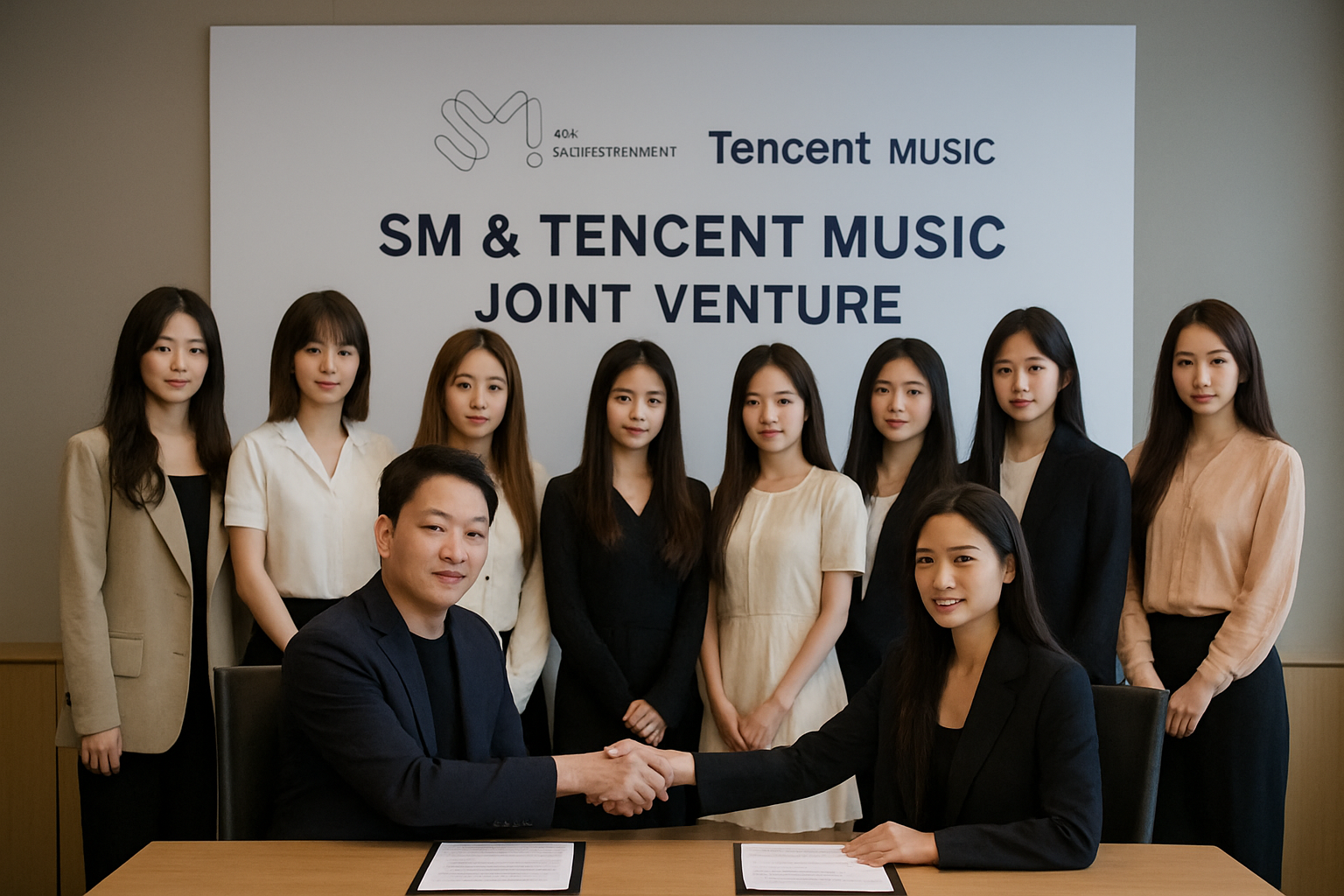
The new venture will manage Greater China activity for select SM artists and prepare a Chinese idol group for debut.
SM Entertainment and Tencent Music Entertainment Group have set up a Beijing joint venture, STE, in a move that gives the two companies a formal base for artist development and management in Greater China.
The venture arrives after a memorandum of understanding the companies signed in May 2025. SM said STE will run auditions for a new Chinese idol group and handle its management in China after debut. The company is targeting a launch within two to three years.
Zhoumi takes the top job
Super Junior-M member Zhoumi has been named CEO of STE. SM said he brings nearly 20 years of experience in the K-pop system, along with management experience from his work as a director at SM’s Chinese subsidiary.
Zhoumi said the joint venture was built on “solid trust and strategic vision” between SM and TME. He said he plans to combine SM’s “strengths in IP and content production” with what he called the “unique characteristics” of the Greater China market.
That appointment matters. This is not a symbolic title. STE is being positioned as the operating arm for a market where local execution, language, and promotion strategy can make or break a project.
What STE will control
SM said STE will take over Greater China management for three of its artists: NCT DREAM’s Renjun, WayV’s Yangyang, and Xiaojun. The company said the venture will handle that work exclusively and provide more localized promotion and support for their entertainment activities.
That gives STE a clear mandate from the start. It is not just a development vehicle for a future group. It is also the management structure for existing SM talent with China-facing careers.
SM’s roster includes aespa, NCT, Super Junior, EXO, Girls’ Generation, Red Velvet, and Riize. TME operates QQ Music, Kugou Music, Kuwo Music, and karaoke platform WeSing, making it the largest music streaming operator in China.
A deeper SM-TME alignment
TME became SM’s second-largest shareholder in May 2025 after buying HYBE’s entire 9.38% stake in the company for KRW 243.35 billion, or about $177 million at the time. Kakao and Kakao Entertainment together hold 40.28% of SM, making the South Korean tech group the company’s largest shareholder.
STE is the latest sign that TME is building a broader position in South Korean music. In February, it entered a joint venture with JYP CHINA and CJ ENM called ONECEAD, also focused on artist development and management in Greater China. In May, TME co-led an $80 million Series B round in The Black Label, the studio behind key tracks on the KPop Demon Hunters soundtrack. Bloomberg reported that deal valued the company at roughly $660 million.
SM’s China strategy sits inside the company’s broader localized IP plan, which Co-CEO Dmitry YJ Tak outlined in January alongside the SM NEXT 3.0 roadmap. “In China, we are working with Tencent Music Entertainment; in Thailand, with True; and in Japan, we are currently in discussions with multiple partners,” Tak said. “Our focus is on creating locally resonant IP while maintaining SM’s creative identity.”
The timing is notable. K-pop acts have reportedly been unofficially barred from performing in China since around 2016/2017, after South Korea deployed a U.S. missile defense system. At the same time, China overtook Germany to become the world’s fourth-largest recorded music market in 2025, growing 20.1% year over year, according to IFPI. South Korea ranked seventh.
STE gives SM and TME a direct structure for working that market, with a local CEO, a China-based venture, and a pipeline aimed at both new acts and existing artists already tied to the company’s roster.