

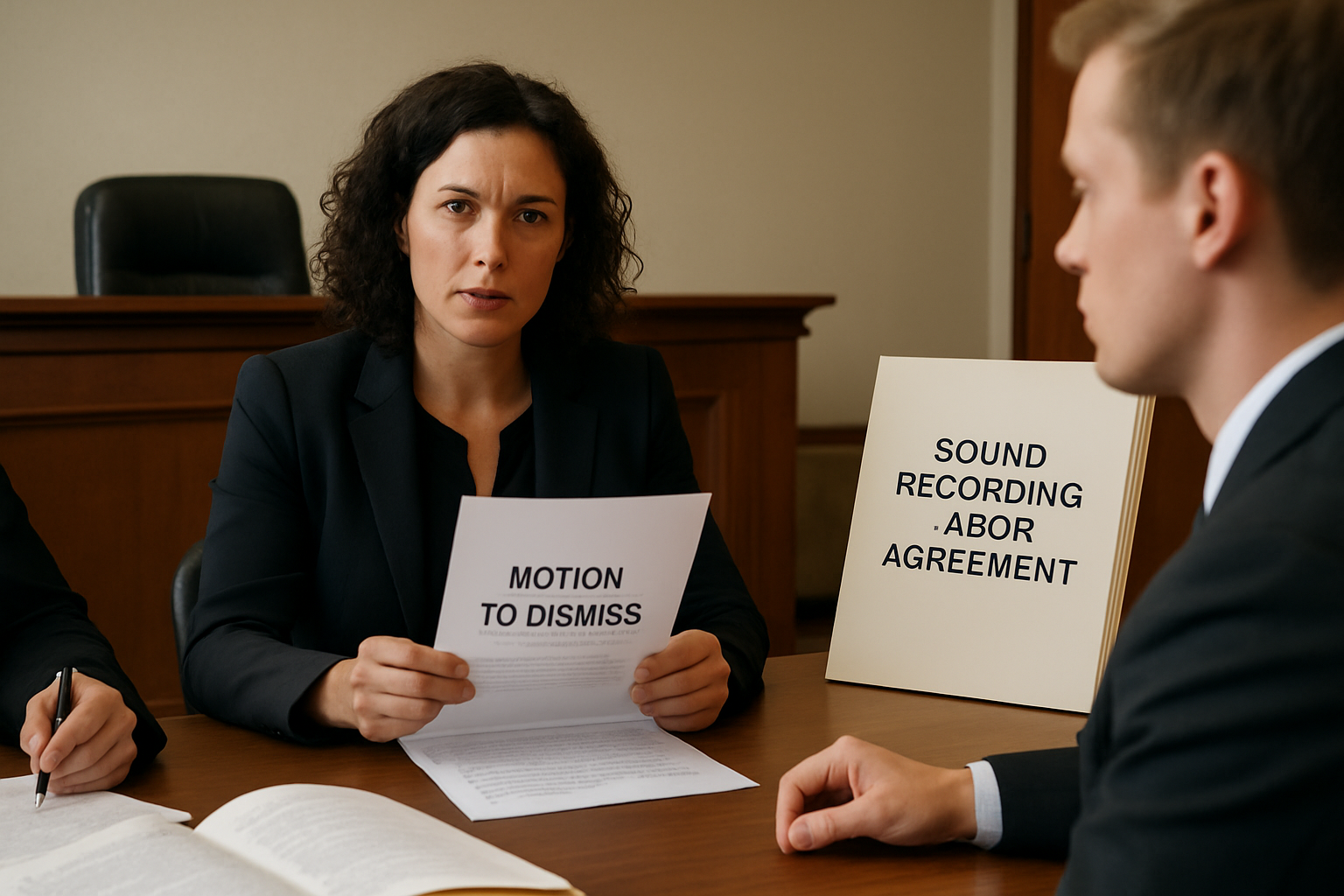
The musicians’ union says Universal and Warner licensed member recordings into AI systems without payment, and that the labels’ own contract language supports the case.
The American Federation of Musicians is pressing ahead in its lawsuit over major-label AI licensing deals, telling a New York federal court that Universal Music Group, Warner Records and Atlantic Recording Corp. used members’ recordings for “commercial exploitation” without paying them.
In a filing submitted Friday, Sept. 4, the union opposed the labels’ motions to dismiss and argued that the dispute turns on the plain language of the Sound Recording Labor Agreement, the collective bargaining agreement between AFM and the record companies. The case centers on Article 21(a), which covers what the contract calls a “new use” of a recording — a use not otherwise covered by the agreement.
The union’s position is blunt: the labels licensed recordings made by AFM members to AI companies, those recordings were fed into AI systems, and the musicians were not compensated.
The contract fight now sits at the center of the case
AFM first sued in June and filed an amended complaint on July 24, alleging breach of the SRLA. Universal moved to dismiss on Aug. 5, arguing that Article 21(a) does not set its own rate and instead points to whatever separate AFM agreement governs the new use. Because no agreement covers AI use, Universal said, no payment is owed. Warner Records and Atlantic filed their own motion on Aug. 14.
The union says that reading is too narrow. Its brief argues that Article 21(a) is “reasonably susceptible to more than one interpretation,” and that its own reading is enough to survive dismissal. AFM says it is not asking the court to rewrite the contract, only to enforce the payment and notice regime the parties already wrote into it.
“The AFM does not ask the Court to rewrite the SRLA or supply terms the parties did not agree to,” the filing says. “It asks the Court to enforce what the parties wrote: a payment and notice regime when a signatory company uses a covered recording for a purpose not covered by the SRLA.”
AFM points to the labels’ own AI lawsuits
The union is also leaning on the copyright cases Universal, Warner and other record companies filed against Udio and Suno on June 24, 2024. Those complaints accused the AI companies of “replacing the work of human artists with massive quantities of AI created sounds” that would “substantially dilute the royalty pools paid out to artists,” and warned that AI-generated recordings could “overrun the market for human-made sound recordings.”
AFM says the labels cannot now argue that the same kind of AI use requires no payment under the union contract. The brief also cites the companies’ public statements about their settlements with Udio and Suno, which were framed as a commitment to artists and songwriters and as a win for the creative community. AFM says its members did not share in those settlement proceeds.
The union’s filing reproduces a comment from U.S. District Judge Edgardo Ramos during a July 21 pre-motion conference. According to the transcript quoted in the brief, Ramos asked the labels: “You presumably now, based on what Mr. Asad has said, are using that music and have licensed with AI companies to train their models and are therefore, presumably, benefiting from that use. And so why shouldn’t you pay the authors of that music?”
Notice, sampling and bargaining history
AFM is also attacking the labels’ reading of the contract’s notice requirement. The union argues that if a company could avoid filing notice and then use that failure as a defense, the notice clause would be meaningless. “In other words, a company’s own failure to provide notice would shield it from liability for that very failure,” the brief says.
The filing goes further, saying the SRLA’s sampling provisions already supply a rate reference for part of the conduct at issue because they cover encoding part of a recording into a computer for playback in another song. Even under the labels’ interpretation, AFM says, that makes dismissal premature.
AFM also points to bargaining history. In the July 21 hearing, Warner’s counsel described how the video game and foreign licensing provisions were added to the SRLA after earlier disputes over whether existing AFM agreements covered those uses. The union says that history shows the parties have previously resolved disputed uses at the bargaining table, not by assuming they were free.
The case lands as AFM and the labels negotiate the next SRLA, with AI at the center of those talks. Sony Music, which has not settled with either AI company, is not a party to the case. Briefing on the dismissal motions is due on Sept. 11.
Universal and Warner have already cut separate deals with the AI companies at the heart of the dispute. Warner settled with Udio in November 2025 and then became the first major to settle with Suno days later. Universal reached a settlement and licensing deal with Udio in October 2025 and has not settled with Suno.
AFM is represented by Eyad Asad of Cohen, Weiss and Simon LLP.