

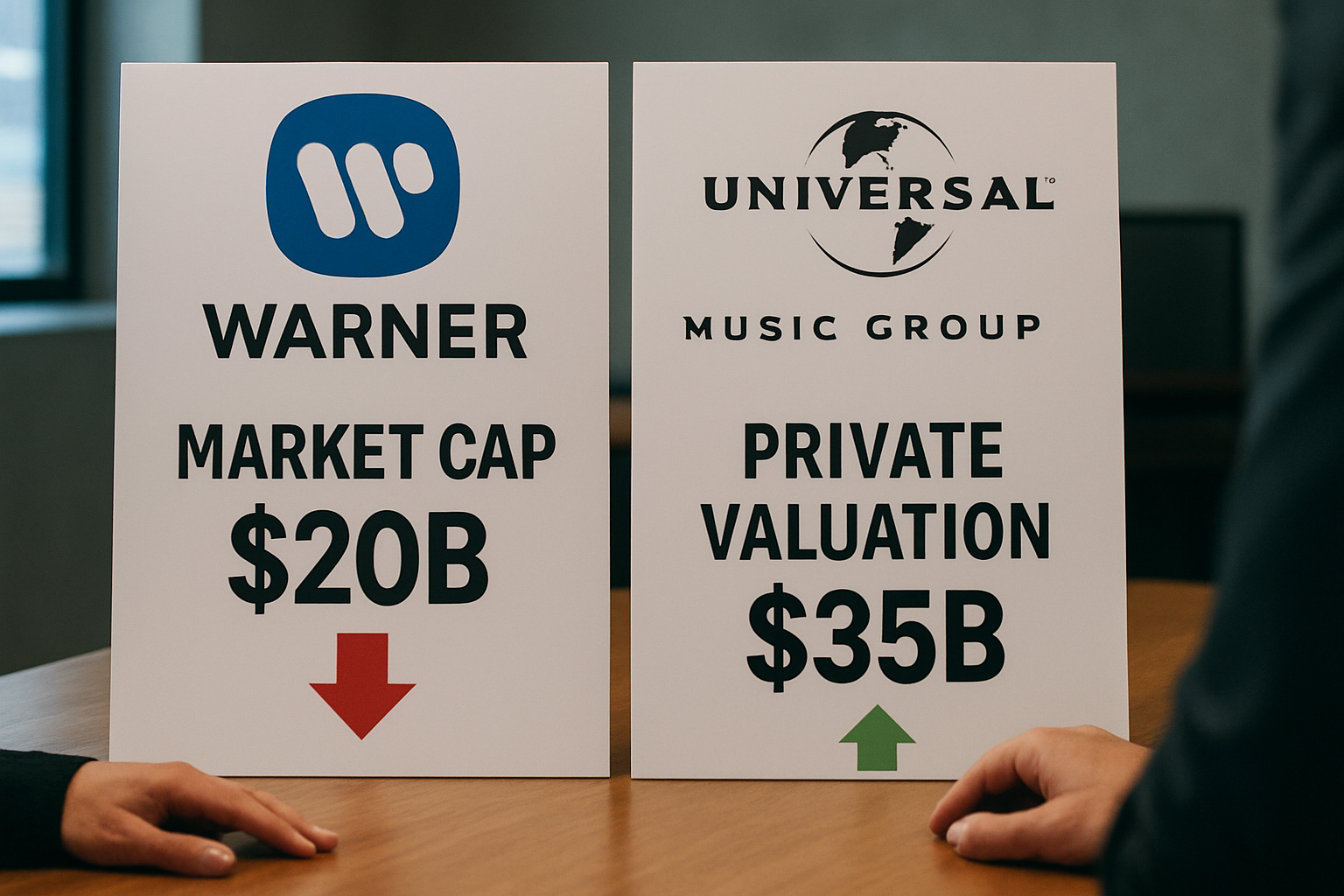
A new BMG-Concord benchmark has sharpened the question hanging over Warner Music Group and Universal Music Group: does the public market still make sense for either company?
The music business has a valuation problem, and it is getting harder to ignore. On the same day the BMG-Concord merger was completed, Warner Music Group’s market cap sat at $14.6 billion. The newly combined BMG, valued privately at roughly $15 billion, landed in the same neighborhood.
That comparison is not a perfect one. Warner carries debt, which lifts its enterprise value to about $19 billion. Even so, the gap between what public investors are willing to pay for Warner and Universal Music Group, and what private capital is assigning to comparable assets, has become impossible to dismiss.
BMG-Concord sets a private-market benchmark
The BMG-Concord deal matters because it gives the market a fresh reference point. MBW’s Tim Ingham has previously said the private financial mechanics of the merger valued each company at roughly $7.5 billion, using an approximate 20x blended multiple. On that basis, the combined enterprise value of “new BMG” lands around $15 billion.
By BMG’s own projections, the company expects $730 million in EBITDA this year on $2.2 billion in revenue. Warner, by contrast, posted $3.6 billion in revenue and $830 million in adjusted OIBDA in the first half of calendar 2026 alone. Put another way, Warner is on track to finish 2026 at roughly three times BMG’s revenue and about twice its profit.
The margin picture is different. BMG’s 2026 projections imply a 33% EBITDA margin, while Warner’s first-half figures point to 23%. BMG is targeting a 40% to 50% margin over the mid-term, with annual EBITDA of $1.2 billion. Warner, for its part, has said it wants to push its margin into the “high-20s” over the medium to long term.
Public markets are not rewarding the numbers
Those are not weak operating results. Warner said subscription streaming revenue rose by double digits year over year in the first six months of 2026. Yet the stock has not responded in kind. At around $28 a share, Warner is still trading at close to half its 2021 peak of $50.
Universal is dealing with a similar disconnect. After a one-day 25% drop in late July, UMG’s market cap fell from above €50 billion as recently as July 2025 to around €26 billion today. The public market has been willing to punish both companies even as their underlying businesses remain large, profitable and strategically important.
That is the real story here. Public enterprise value for Warner and Universal is running at roughly 11x annual adjusted EBITDA or OIBDA. A comparable private-market player is being valued at nearly twice that multiple. The spread is not a rounding error. It is a signal.
Warner’s control structure makes a buyout easier to imagine
If one of the majors were to go private, Warner is the easier case to sketch out. Access Industries, controlled by Len Blavatnik, owns about 72% of Warner’s economic interest and roughly 98% of its total combined voting power, according to the company’s latest annual report. Warner is formally classified as a “controlled company” on Nasdaq.
Public minority shareholders hold around 28% of the economics and just 2% of the votes. At today’s price, buying them out without a premium would cost Access in the region of $4 billion. Blavatnik has done this before. Warner was listed on the NYSE in 2005, taken private by Access in a $3.3 billion deal in 2011, then returned to the market on Nasdaq in 2020.
That history matters. So does the fact that the current public valuation is not giving Warner much credit for scale, streaming growth or margin expansion. If the market keeps discounting the stock, the logic for staying public gets thinner.
Universal has no controller, but it does have a bloc
Universal’s structure is different. There is no controlling shareholder and the company operates on a one-share, one-vote basis. But the register is dominated by aligned long-term holders: Vincent Bolloré at about 18.5%, Bolloré-controlled Vivendi at 9.9%, and Tencent at 11.5%. Together, they account for roughly 40% of UMG’s equity.
Their influence is not theoretical. The three have told the Dutch regulator they vote together as UMG shareholders, effectively as a single bloc. That was on display in May, when Universal rejected Bill Ackman’s Pershing Square proposal to reshape the company on the grounds that it “fundamentally and materially undervalues UMG.”
The question now is whether one or more of UMG’s key stakeholders, looking at a market cap that has been cut down sharply, decides the public market is no longer the best place for the asset. The same question hangs over Warner, only with a simpler ownership map and a familiar private-equity exit route already on the record.
For now, both companies remain public. The market, though, is making the case for a different answer.