

A completed catalog merger and a fresh wave of AI litigation defined the week, with publishers, collecting societies and the U.S. government all moving on copyright.
BMG and Concord have closed their long-awaited merger, while the music business’ fight with AI companies kept widening in court. The week also brought a notable shift from Washington, as the Trump administration backed OpenAI in a fair use case that could shape how the industry argues against model training without licenses.
BMG and Concord finish the deal and name Bob Valentine CEO
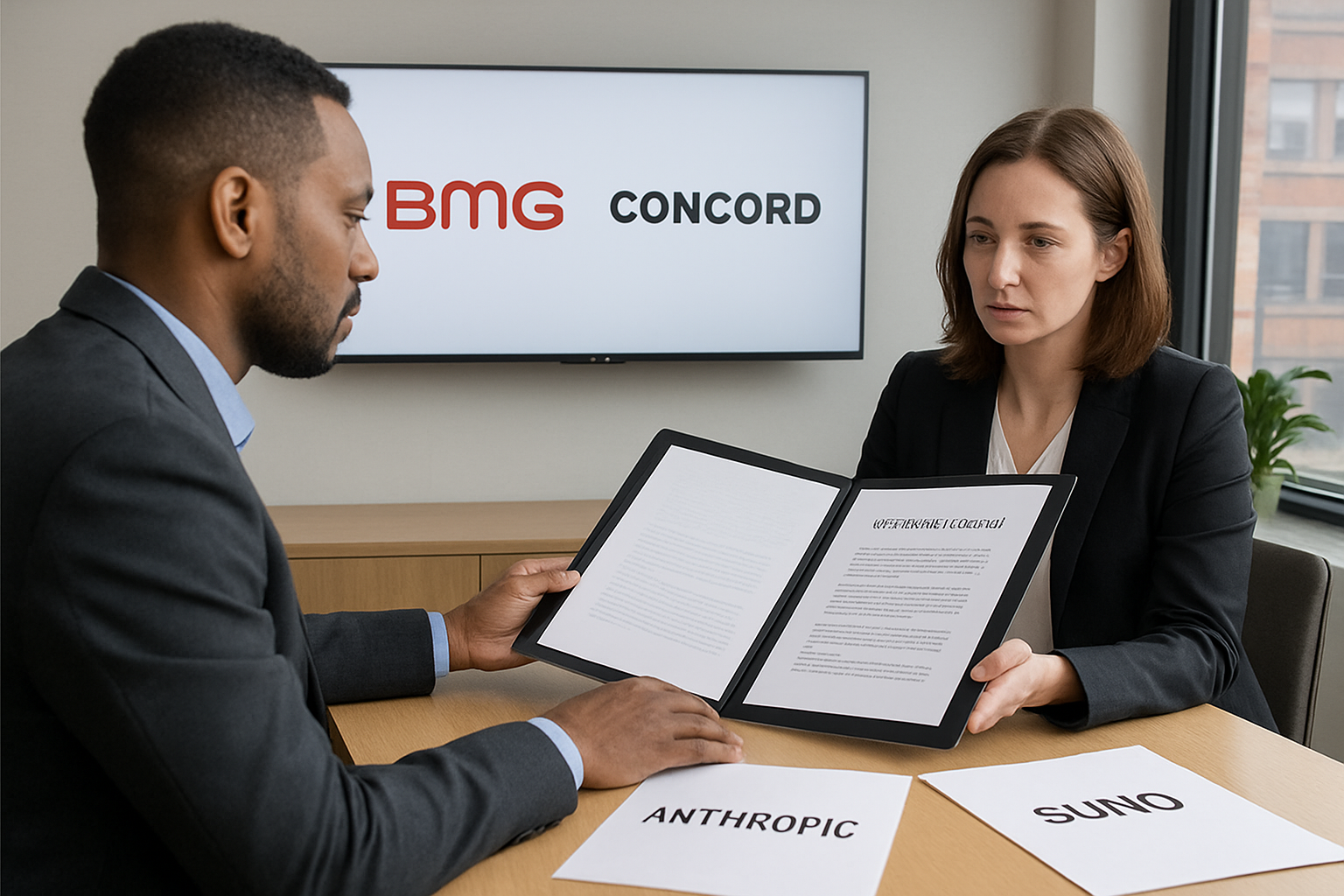
BMG and Concord confirmed on Tuesday, September 1, that their merger is complete. The companies said the transaction received all required regulatory approvals and will create a new global music company with the scale, expertise and capabilities to unlock greater opportunities for creators.
Bob Valentine has been confirmed as CEO of the combined company. The new group will be headquartered in Nashville, with Berlin serving as its European headquarters.
The merger was first announced on April 28, 2026. For executives watching consolidation across publishing and recorded music, the close matters less as a headline than as a signal: the deal is done, the structure is set, and the company now has to prove the logic in the market.
Washington backs OpenAI as fair use fights intensify
The U.S. government told a court this week that AI companies do not violate copyright law when they train their models on written works without a license. The Department of Justice laid out that position in a filing on Tuesday, September 1, in the copyright lawsuit brought against OpenAI by The New York Times.
It appears to be the first time Washington has stepped into one of the copyright cases now stacked up against AI companies. That makes the filing more than a procedural footnote. It gives AI defendants a public-policy argument to lean on, and it gives rights holders another reason to treat these cases as a broader fight over how training data is sourced, paid for and policed.
For music publishers, labels and collecting societies, the timing is awkward. The industry has spent months arguing that unlicensed training on protected works is infringement. The government’s position in the OpenAI case does not settle that question for music, but it does sharpen the stakes.
Publishers take Anthropic to court over Claude training
Sony Music Publishing and Warner Chappell Music filed a lawsuit against Anthropic on Friday, August 28, accusing the company behind Claude of what they called “one of the largest and most blatant ongoing thefts of intellectual property in history.”
The complaint, filed in the U.S. District Court for the Northern District of California, also names Anthropic co-founder and chief executive Dario Amodei and co-founder Benjamin Mann as individual defendants. MBW reported that the case seeks damages in the billions.
This is one of the clearest signs yet that major publishers are moving from warning shots to direct litigation against AI developers. The language is blunt. The target is large. And the case lands at a moment when the legal ground around training data is still unsettled.
Suno faces identity claims and a new collecting society suit
Suno spent the week under pressure from two more fronts. Jason Isbell filed a proposed class action on Monday, August 31, in Boston federal court, alongside Cracker and Camper Van Beethoven frontman David Lowery, Texas blues musician Guy Forsyth and Florida saxophonist Eduardo Calle. The suit focuses on alleged commercial use of artists’ identities, not copyright. That distinction matters.
Separately, Canada’s SOCAN sued Suno for copyright infringement on Wednesday, September 2, in Federal Court. SOCAN says the platform has generated outputs identical or substantially similar to songs in its repertoire, including Joni Mitchell’s “Both Sides Now” and Avril Lavigne’s “Sk8er Boi.”
SOCAN is the third collecting society to sue Suno and the first to file after one of those societies won. That gives the case immediate weight for rights holders outside the U.S., where the same arguments about training, output and substitution are now moving through multiple courts at once.
The week left the industry with a familiar but sharper picture: consolidation at the top, litigation everywhere else, and no sign that AI companies are done testing the limits of copyright law.