

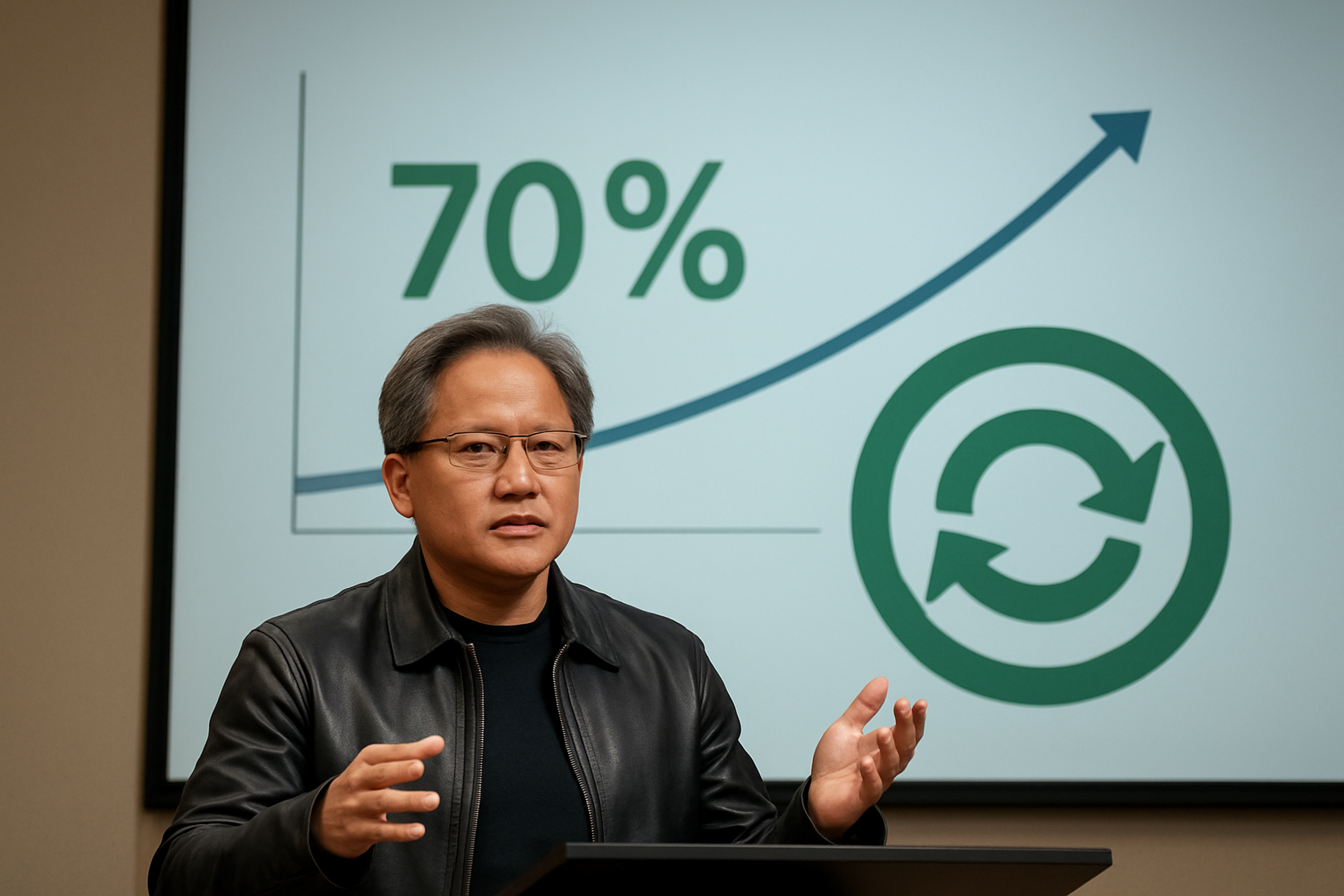
At Goldman Sachs’ Communacopia conference, the Nvidia chief argued the company is embedded so deeply in AI infrastructure that demand is still running ahead of supply.
Nvidia chief executive Jensen Huang used a Goldman Sachs conference stage to make a familiar case with fresh numbers: the company’s AI business is still expanding fast enough to support 70% revenue growth next year.
That is the kind of forecast that keeps investors, rivals and customers watching the same question: how long can Nvidia keep this pace? Huang’s answer was blunt. He says the company is not just selling chips. It is sitting inside the plumbing of the AI economy.
Huang says Nvidia is wired into every layer of AI
Speaking Thursday at Goldman Sachs Communacopia + Technology, Huang argued that Nvidia’s reach now runs from chip suppliers to data center builds to the AI labs and startups spending heavily on compute.
“Nvidia runs every model. Every single lab can use us,” he said, naming Anthropic, OpenAI and Google, along with open-weight models. “We are a foundational platform of the AI ecosystem, foundational platform of the AI industry.”
He also pushed back on the old image of Nvidia as a consumer graphics company. The scale is different now, he said. “One GPU now is not $399. It’s $8.5 million dollars. That’s one GPU, all connected with NVLink, 2 million parts, right? 250,000 kilowatts. That’s a GPU, and we ship thousands of them.”
Huang said the company is tracking “every single gigawatt of land, power, shell around the world,” using the term “shell” to describe a data center building before it is outfitted with computers. He said Nvidia is hearing back from neoclouds, OEMs, clouds and AI-native companies, which gives it a broad view of where demand is headed.
Orders, contracts and the 70% revenue call
Huang pointed to one product in particular: a computer system combining 36 Grace CPUs with 72 Blackwell GPUs. He said sales for that system are growing 27% month to month.
He also repeated Nvidia’s revenue outlook for next year, first disclosed last month after another record quarter. “I think we could grow 70% year over year. We’re confident about that,” he said.
Analysts expect Nvidia to end its current fiscal year at about $400 billion in revenue. A 70% jump would put next year near $680 billion.
That kind of guidance is hard to ignore, especially in a market where the biggest buyers are still building out AI infrastructure as fast as they can. Huang’s message was that Nvidia is not waiting for the cycle to turn. It is helping define the cycle.
The circular-deal question is not going away
Huang’s confidence also revived a familiar concern: Nvidia’s investments in companies that then buy its products. The practice has drawn comparisons to the kind of circular financing that helped sink earlier internet infrastructure suppliers, including Lucent Technologies.
His answer was part joke, part defense. “Well, it’s not circular because we put a little bit of money in, and a lot of money comes back,” he said. “I look at the spreadsheet, we put in $1 and $100 comes back in. Is that circular? If that is, let’s do more of that.”
He said Nvidia does not invest unless there are real contracts in place and revenue coming from customers. Huang said he has seen $100 billion worth of such contracts. “I’m not taking any risks. … I need a sure thing,” he said.
For now, the company’s position remains unusually strong. Hyperscalers are building their own chips. AI labs are doing the same. New public rivals like Cerebras and startups such as Etched are trying to carve out space. Huang’s argument is that none of that has changed Nvidia’s role at the center of the market.
The longer-term question is whether that center holds. AI companies will eventually get more efficient with infrastructure and token use. The spending spree will not last forever. But Huang is betting that the next stretch still belongs to Nvidia, and that the numbers will keep backing him up.