

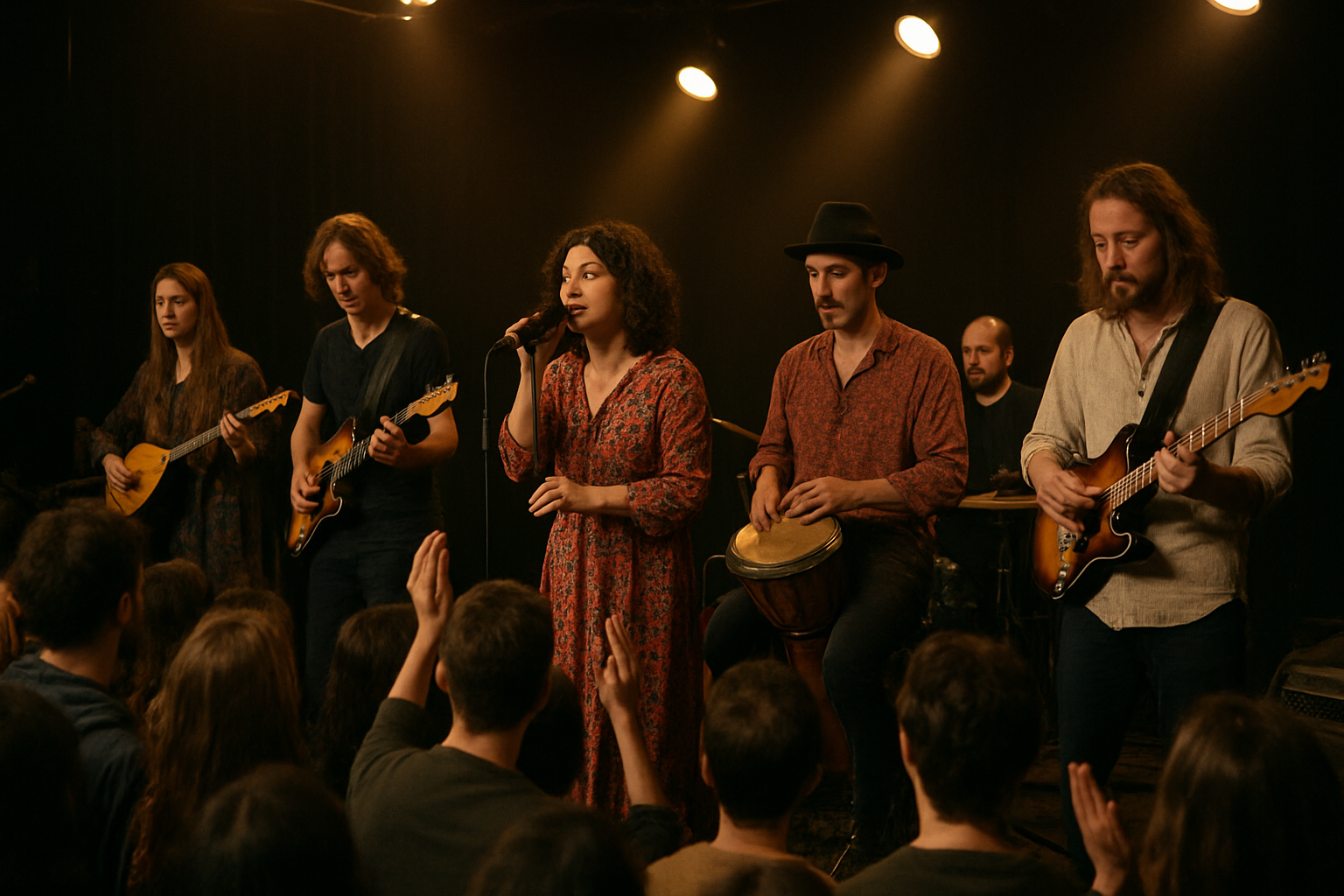
The Dutch-Turkish psych band is filling U.S. rooms without translating its sound for American ears.
Altın Gün’s North American tour this month is no longer a test case. The Amsterdam-based Dutch-Turkish band has already proved that its music can travel, and sell, without sanding down the parts that make it distinct.
The September run includes Brooklyn Steel in New York and the Orpheum Theatre in Los Angeles, following a previous U.S. stretch that sold out multiple dates in markets including Portland and Seattle. For a band built around psychedelic reinterpretations of traditional Turkish and Anatolian music, with lyrics largely in Turkish, that matters. This is not a heritage act playing to one narrow audience. The rooms are full of younger listeners, and the crowd is broader than the usual diaspora lane.
They never tried to make it easier
For years, “crossing over” meant changing the music until it fit a Western frame. Artists recorded English versions, leaned on familiar production, or softened the most culturally specific parts of the sound. Altın Gün has done the opposite. The specificity is the point.
The band’s latest album, Garip, is a full-length tribute to Neşet Ertaş, the revered Turkish singer-songwriter and bağlama player who carried the Anatolian folk-bard tradition into the modern era. The record’s ten songs are Ertaş compositions rebuilt with psychedelic rock, funk, synths, Arabesque strings and bursts of saxophone. The result is not a translation for American listeners. It is an invitation to meet the music where it already lives.
For vocalist, keyboardist and bağlama player Erdinç Ecevit Yıldız, the project is personal. His parents came from the same region of Turkey as Ertaş, and he grew up hearing the musician’s cassettes at his grandfather’s home. Yıldız has described traditional Turkish music as “the blues of the Turkish people” — songs about love, hardship, loneliness and ordinary life. That emotional language crosses borders faster than any lyric sheet.
Streaming changed who gets to show up
Altın Gün’s audience is also a sign of how streaming has altered the touring equation. Listeners no longer need a specialty record shop, a local radio champion or a major-label campaign to encounter music from another part of the world. A Turkish psych track can land in the same listening session as indie rock, disco, funk or electronic music.
That opens the door to several audiences at once. Turkish diaspora listeners may hear family memory and cultural inheritance. Psychedelic-rock and rare-groove fans may come for the fuzz guitars, analog keyboards and rhythmic pocket. Younger listeners already moving between Afrobeats, K-pop, Latin music, amapiano and regional Mexican music may not see language as a barrier at all.
What forms is not one big mainstream audience. It is a coalition of smaller ones that overlap in the same room. Altın Gün has spent years turning that overlap into ticket sales, with Coachella appearances and extensive touring helping build what its label describes as an increasingly global following.
Specificity still needs infrastructure
None of this happened by accident. Altın Gün still has an American label in ATO Records, experienced representation, festival exposure and years of international touring behind it. This is not a story about uploading a few songs and waiting for an algorithm to do the rest.
It is a reminder that accessibility does not have to mean generalization. A highly specific musical identity can now gather listeners across cities, platforms and subcultures until a supposedly niche audience is large enough to fill theaters. For independent artists, that is the useful lesson. Reach does not always require compromise.
Altın Gün’s run suggests a newer version of crossover: not an artist stepping away from its culture to find an audience, but enough listeners moving toward the artist to make the room bigger. Nobody else on the circuit makes these songs sound quite like this, and that is still the draw.