

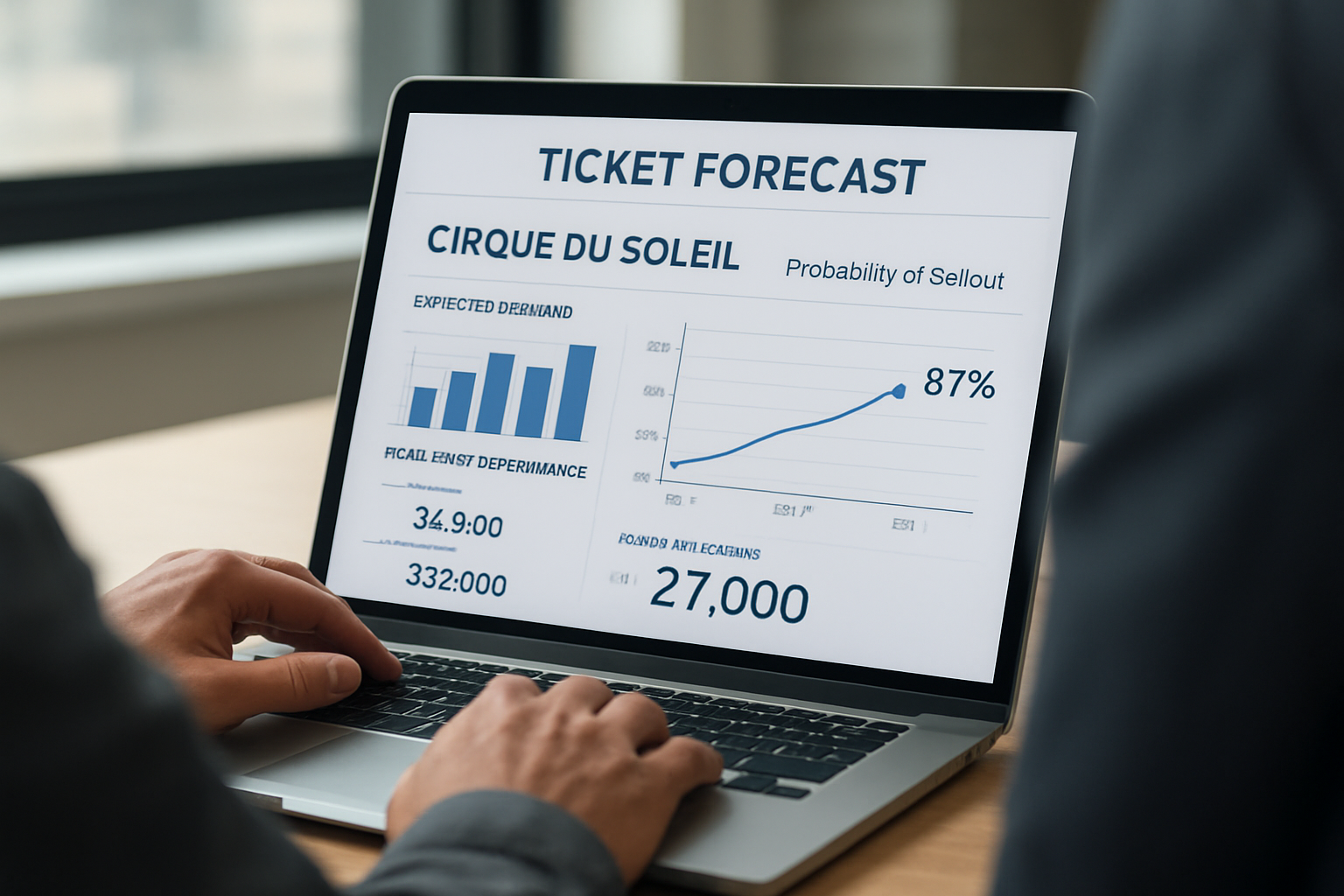
The live entertainment marketing firm says its new NYBA OS platform used real ticketing data to forecast a Cirque du Soleil sellout and reshape spend in real time.
For years, live entertainment marketing has run on a familiar ritual: commit the budget, launch the campaign, wait for the box office to tell the story later. NYBA Media says that model is outdated.
The company says a six-month beta of its new operating platform, NYBA OS, showed it can forecast ticket demand before a campaign starts, then adjust spend against real ticketing data as sales come in. The clearest test case was Cirque du Soleil ALIZÉ, which NYBA says sold out along the curve its model projected.
Cirque du Soleil became the proving ground
NYBA OS launched publicly on August 14, but the system was tested first with existing clients. One of those closed-beta cases was Cirque du Soleil ALIZÉ, the company’s first European resident show in Berlin.
According to NYBA CEO Markus Hetzenegger, the model compared the production against the company’s campaign archive, which he said includes 75 million tickets sold, about 1,200 campaigns a year across 25 markets, and roughly 400 million euros in analyzed ad spend. The system looked at comparable productions, venues, markets, price points and audience overlap, then generated a forecast before the campaign started.
That forecast included projected ticket sales, sellout probability and a suggested budget split across channels. NYBA says the result held up in practice.
The company says the same approach also worked in beta on Helene Fischer’s tour, which it described as a run of almost 750,000 tickets, and more recently on campaigns for elrow in Málaga and ANYMA in Madrid.
Why NYBA says box office data beats ad dashboards
Hetzenegger argues that ad platforms routinely overstate their own role because each one reports success in isolation. Meta, Google and TikTok can all claim the same purchase, he said, which makes platform-level attribution unreliable if the goal is to understand what actually sold the ticket.
NYBA says it measures against ticketing systems instead. That lets the company track which channel is converting, what it costs, and when creative starts to wear out. Budget can then move week by week based on actual ticket sales, not dashboard math.
The platform also generates creative variations from assets that performed well on comparable shows, then cuts underperforming ads live after human approval. In NYBA’s view, that makes the campaign less of a static media buy and more of a live operating system.
One result surprised the company itself. NYBA says its work with TikTok, where it has been a performance partner since 2019, showed the platform acting more as a discovery layer than a direct conversion engine. The first contact with a show often happens there, the company said, while the purchase closes on Google or Meta. That effect, NYBA argues, is easy to miss if the only lens is ad-account attribution.
The first 72 hours matter most
Hetzenegger says the numbers that matter most are simple: real tickets sold and the speed of sales in the first 72 hours of an on-sale. That early window, he said, tells more about a show’s outcome than any dashboard metric.
He also says the platform has cut planning time sharply. Campaigns that once took teams weeks to map now take about 15 minutes because the first draft is already embedded in the history of prior campaigns.
NYBA says the beta points to a broader shift in live entertainment: forecasting moving upstream from marketing into booking. If a promoter can see sellout probability before signing an offer, venue size and routing become data decisions. The question changes from whether a show can be marketed to whether it belongs in a 4,000-cap room or a 6,500-cap room, and which city should go first.
The company also says the model is already changing how promoters think about adding dates. When demand from the first on-sale feeds back into the system, the decision to add a second night becomes arithmetic, not a gamble.
NYBA says the platform can also recommend spending less on shows that are already likely to sell out, and shifting that money to titles that need the push while demand is still cheap to build. For a business that has long treated marketing as a post-booking expense, that is the point. The spend is no longer just being tracked. It is being steered.