

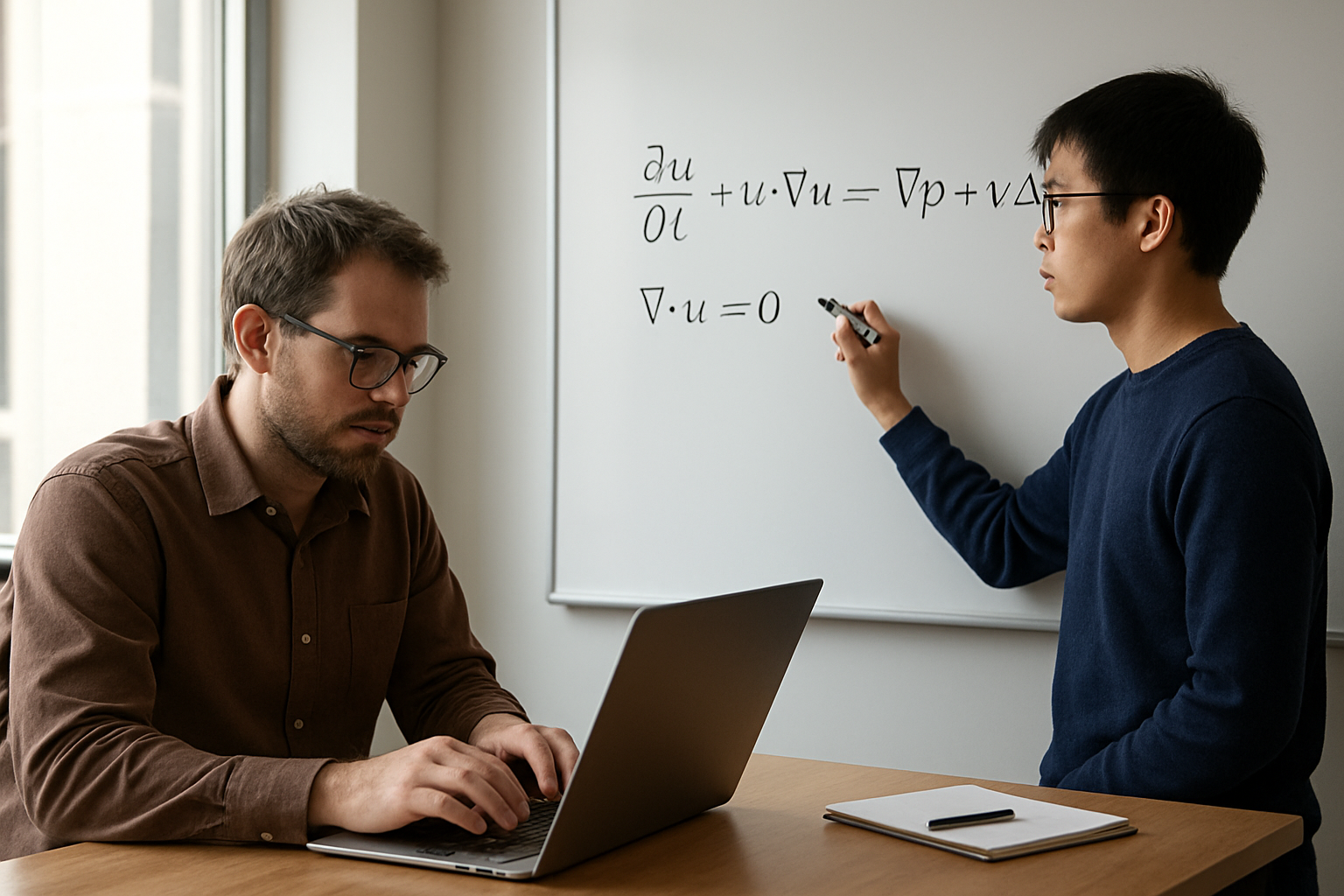
Tristan Buckmaster says OpenAI moved on the same problem after learning of his progress, while OpenAI’s math lead calls the claim false and inflammatory.
OpenAI is facing an ugly accusation from an NYU mathematician who says the company jumped into a career-defining proof problem after learning his team was close to a solution.
Tristan Buckmaster announced three proofs on Tuesday, including a preliminary finding on the Navier-Stokes existence and smoothness problem, one of the Clay Mathematics Institute’s seven Millennium Prize problems. The work was done with Anthropic mathematician Levent Alpöge and used both Codex and Claude. The math matters on its own. So does the dispute that Buckmaster says followed it.
How the dispute started
In his statement, Buckmaster said there was “another part of this story” that he wished he did not have to address. He said that while he and Alpöge were finalizing their results, they learned that “information about our progress had been passed to OpenAI.”
When they contacted OpenAI, Buckmaster said, they were told the company had already achieved a full proof of the central problem. But when he and Alpöge asked when OpenAI had started the work and how much human input was involved, the answers, he said, became evasive.
According to Buckmaster, “an entire team had been working on the problem,” and “an insane amount of compute had been used.” He said they were eventually told that the first prompt had been sent only in the past few days, after OpenAI had learned about their work.
If that account is accurate, it suggests OpenAI may have moved quickly on a problem once it saw another route to the answer. Buckmaster says the tactic his team used was not the obvious one. “Almost nobody else I know of was working on it,” he wrote. “It is not the direction one arrives at in a few days by giving a model the problem statement.”
OpenAI pushes back
Sébastian Bubeck, who leads OpenAI’s mathematical research, rejected Buckmaster’s account. He called the claims “false and inflammatory” and said he came into the discussion “following academic norms.”
“Anyone who knows me knows that academic standards are of the highest importance to me,” Bubeck wrote. He said he would issue a fuller statement later.
The fight centers on one of the most famous open problems in mathematics. The Navier-Stokes equations are central to fluid mechanics, but their theoretical behavior remains poorly understood. A proof would be a major advance in mathematical physics and would place the winner among the few who have solved a Millennium Prize problem.
Anthropic, Codex and the credit fight
Alpöge works at Anthropic, though Buckmaster said the research was not being done on the company’s behalf. The pair used a mix of models, but relied primarily on OpenAI’s Codex.
Buckmaster also said OpenAI appeared to object to Alpöge’s Anthropic affiliation and that Bubeck asked him to remove Alpöge’s credit as part of a proposed compromise. Buckmaster says that when he pushed to make the dispute public, Bubeck asked, “Why would you ruin your career?” He says Bubeck later added: “If you don’t want me to be nice, then I don’t have to be nice.”
He also raised a separate concern: because he used Codex extensively while assembling the project, information from his work could have fed back into OpenAI’s own efforts. OpenAI reserves the right to train models on Codex interactions, though users can opt out. Buckmaster said that if OpenAI’s model had been trained on his interactions, it could have regurgitated his work when given a similar problem.
OpenAI did not respond to a request for comment on that possibility.
Buckmaster says he is not accusing anyone of anything. He says he is trying to keep the record straight before a sequence of announcements hardens into a version of events he believes is wrong.
“I have not seen OpenAI’s proof,” he wrote. “I do not know what their model did, or how. I do not know whether our data was used. I am not accusing anyone of anything. I am stating what I was told, when, and what was proposed to me.”
The episode is likely to sharpen the debate over AI’s role in mathematical research, and over how much credit belongs to the models, the teams behind them, and the people whose work may have pointed the way.