

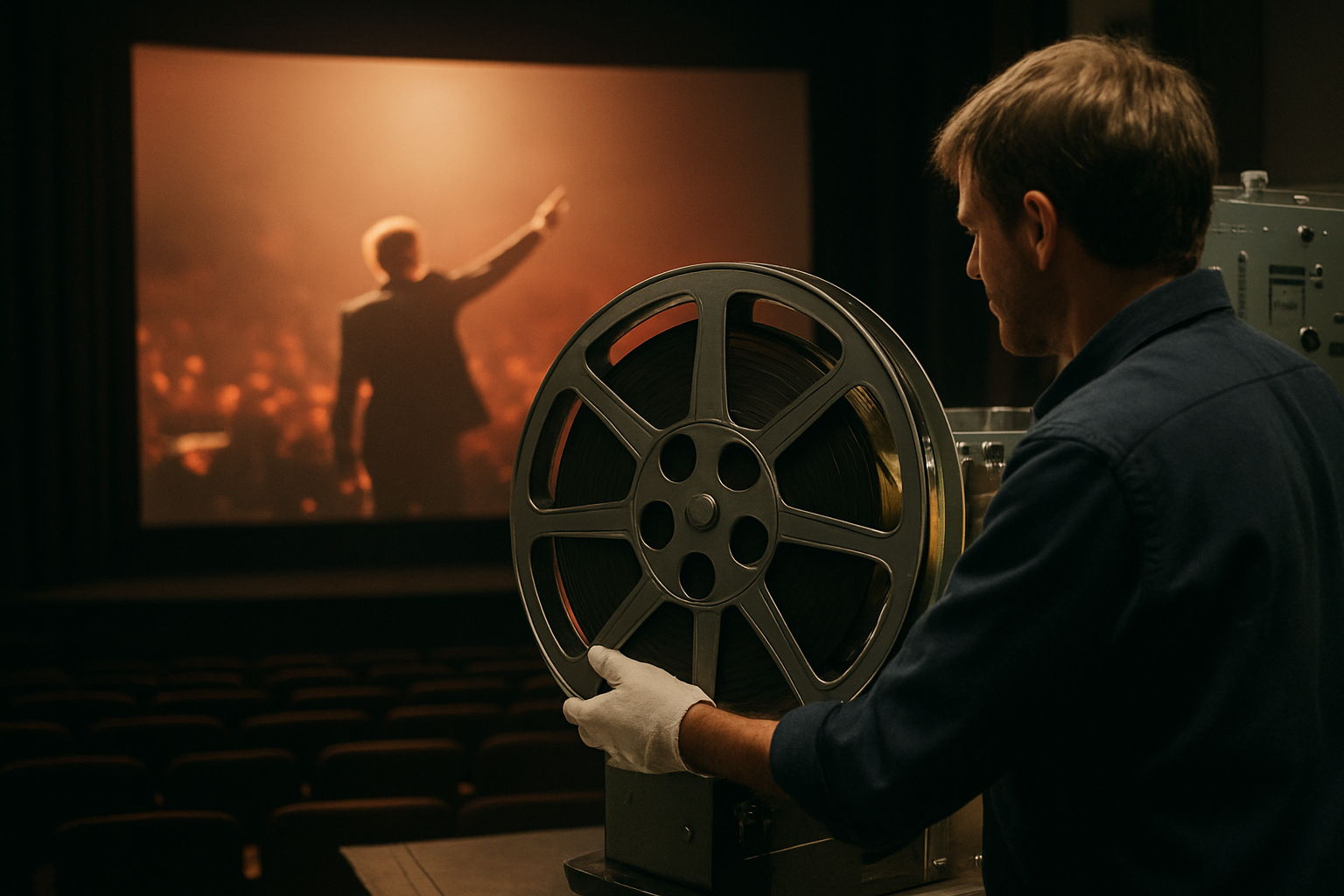
Paul Thomas Anderson and Brady Corbet are treating live performance as film, not content, and the theatrical rollout is part of the point.
Two of the most exacting filmmakers working today are making a case that concert films can still be event movies. Paul Thomas Anderson has shot Cameron Winter at Carnegie Hall on 16mm and 35mm for Janus Films and Criterion. Brady Corbet has captured David Byrne’s Who Is the Sky? tour in 70mm. Neither project is built for the feed. Both are built for theaters.
From phone clips to film prints
Live music has become easy to flatten. Night after night, performances are chopped into vertical clips, crowd reactions, and shaky fragments passed around as social media bait. The stage gets reduced to a few seconds of proof that something happened.
These new concert films push in the opposite direction. Anderson’s Cameron Winter at Carnegie Hall documents Geese frontman Cameron Winter’s sold-out solo performance at the New York institution in December 2025, with Winter at a Steinway grand piano. Anderson directed and shot the 75-minute film with a crew that included Benny Safdie. Producer Ariel Rechtshaid recorded the music. The world premiere is set for the New York Film Festival on October 1, with Anderson and Winter attending.
Film at Lincoln Center says the movie balances intimate images of Winter with the scale of Carnegie Hall itself. That matters here. The point is not to simulate being in the room. It is to make the room legible as cinema.
Janus and Criterion are treating the rollout that way. Beginning November 20, supervised 35mm prints made by FotoKem will travel through North American theaters through January 18. Audiences will not just be watching a concert on a screen. They will be watching an actual film print, which is part of the draw.
Byrne and Corbet take the format bigger
David Byrne’s untitled film of his Who Is the Sky? tour goes even further. Brady Corbet captured the show over multiple performances in Byrne’s hometown of Baltimore using both 8-perf and 15-perf 70mm formats. The production features 13 musicians, singers, and dancers moving through music, choreography, visual art, and storytelling.
Byrne said he did not fully grasp how much 70mm would change the presentation until Corbet sent early frames. The format, he said, captured the show’s widescreen scale in a way he had never seen before. Release and distribution details have not been announced.
Byrne knows the territory. Jonathan Demme’s Stop Making Sense did not just preserve a Talking Heads concert; it turned the performance into a piece of cinema. Spike Lee later brought Byrne’s American Utopia to the screen. Corbet is now joining that line, treating Byrne’s stage work as material for a film rather than documentation.
The old concert film playbook still works
There is a long history behind this approach. D.A. Pennebaker’s Monterey Pop turned the 1967 festival into cultural history. The Maysles brothers and Charlotte Zwerin’s Gimme Shelter began as a Rolling Stones tour film and became a grim portrait of Altamont. Adrian Maben’s Pink Floyd: Live at Pompeii removed the audience entirely and set the band in an ancient Roman amphitheater. Martin Scorsese’s The Last Waltz, shot with seven 35mm cameras, remains as much a Scorsese film as a record of The Band’s farewell.
Those films were not trying to imitate the experience of standing in the crowd. They asked what cinema could reveal that the room could not. That question is back because the live business and the theatrical business are both looking for events people will leave home for.
Live Nation reported 159 million concert attendees in 2025. Movie theaters have had a slower, uneven recovery, but the summer 2026 domestic box office reached about $4.6 billion, its strongest summer since the pandemic. Audiences still show up when the experience feels singular.
That is the opening these projects are using. The concert film is no longer just a record of a night onstage. In the right hands, it becomes a theatrical object, a premium format, and a reason to leave the house.