

Olivia Rodrigo’s inaugural women-led festival raised $20 million, but its equal-billing poster may have been the sharper statement.
Olivia Rodrigo’s inaugural Daisy Chain Fields festival made its point before the first set started. The single-day event drew 45,000 people to Great Park in Irvine, Calif., last week, raised $10 million for ten nonprofits supporting women and girls, and then doubled that total when Melinda French Gates matched the amount. The final tally: $20 million.
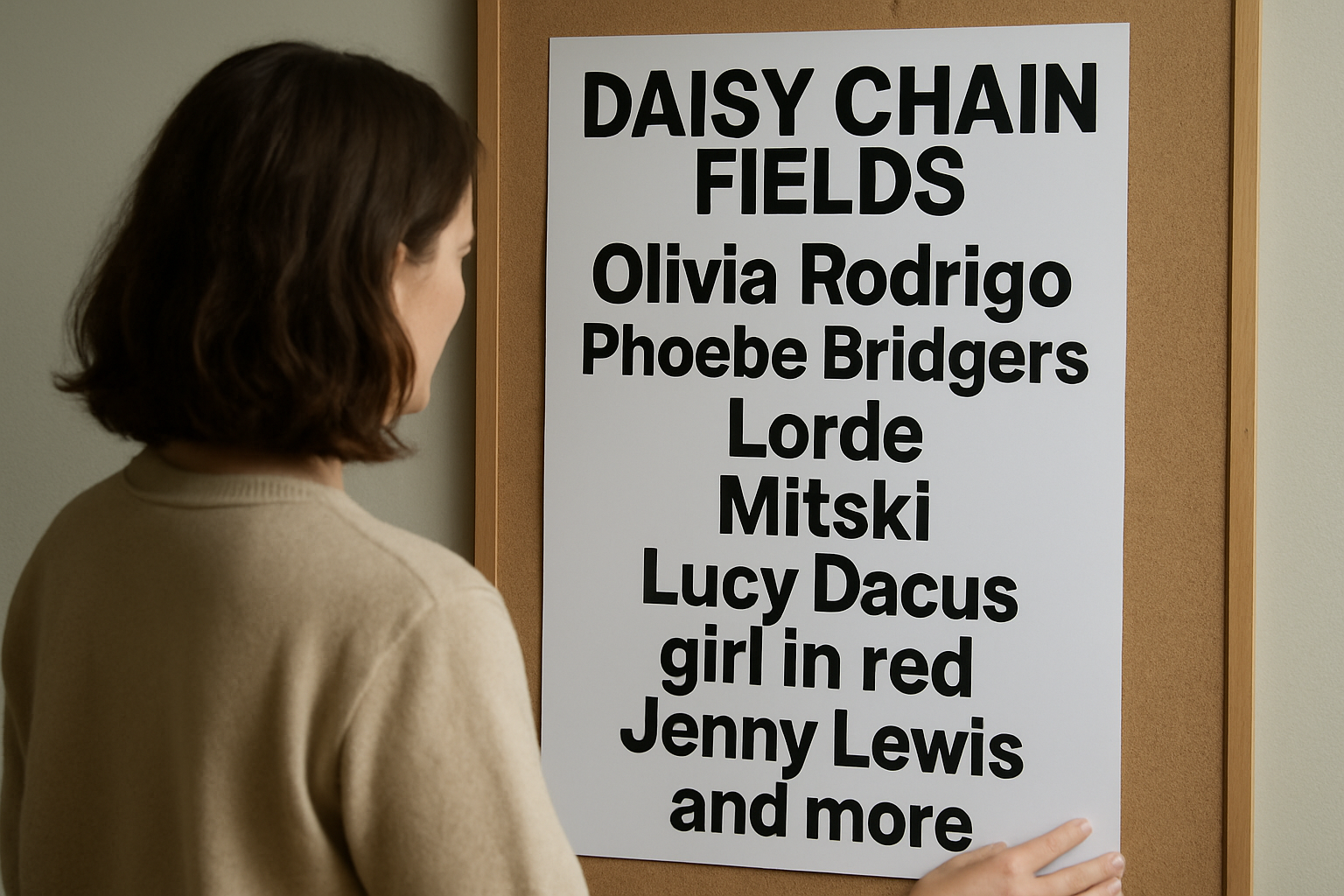
That was the headline number. The more unusual move was visual. On the poster, every artist was given the same-sized type and listed alphabetically. No oversized headliner. No tiny names buried at the bottom. No graphic shorthand for who mattered most.
The lineup itself carried the same logic. Bikini Kill, The Breeders, Garbage, Santigold, Mitski, Doechii, Chappell Roan and Rodrigo were spread across two stages that never overlapped, so fans did not have to choose between acts based on status or slot. Every participating artist waived their fee.
The poster was the power move
Festival posters usually work like a hierarchy chart. Font size, placement and spacing tell the industry story before the music does. The biggest names are the draw. The smaller ones are the add-ons. That structure reflects real differences in ticket demand, bargaining power, set length and fees, but it also reinforces them.
Daisy Chain Fields declined that script. Equal lettering did not make every artist equally famous, and it did not erase the fact that Rodrigo closed the night. But it did refuse the usual visual ranking system that tells audiences, press and promoters whose set is essential and whose can be skipped.
For a festival built around women, that choice mattered. The event was not just saying women should be on the bill. It was saying they should not be sorted into a pecking order the moment the poster goes public.
Why gender equity is about placement, not just presence
Festival gender imbalance has never been only about how many women are booked. It is also about where they appear. In 2018, Pitchfork analyzed nearly 1,000 artists across 20 major festival lineups and found women were especially scarce in the largest-font tiers. Four festivals had no female or mixed-gender acts among their top-billed 10%.
That is the gap Book More Women has spent years exposing. The group began in 2018 by removing male-only acts from festival posters, turning familiar lineup graphics into blunt snapshots of who was missing. Its method has since become more exacting. Rather than counting a band as “diverse” because one member is a woman or nonbinary, it now looks at the individual musicians who are actually being paid to perform.
Across nine major U.S. multi-genre festivals in 2025, 38% of acts included at least one woman or nonbinary musician under the group’s original method. Count the people onstage, though, and the picture changes: women represented 21.6% of musicians, nonbinary artists 1.6% and men 77.4%. Across 130 festivals tracked in 2024 and 2025, just 17.3% of booked musicians were women and 1% were nonbinary.
What Daisy Chain Fields borrowed from Lilith Fair
Daisy Chain Fields was inspired in part by Lilith Fair, the late-1990s touring festival Sarah McLachlan launched after encountering an industry that resisted booking women back-to-back. The comparison is apt. Both festivals were built to challenge the assumption that women could be included only as exceptions, not as the organizing principle.
That is also why the Daisy Chain Fields poster landed so cleanly. It did not just advertise a women-led bill. It rejected the old hierarchy that turns a lineup into a status report. The design said the same thing the booking did: no one here is filler.
That distinction matters in a business where visibility still shapes leverage. A poster can tell the market who is bankable, who is emerging and who is being treated as optional. Daisy Chain Fields chose not to use that language. It let the music and the mission stand on the same level, and then it backed that up with a schedule that gave every act a real audience.
For an industry that still talks about equity as if it begins and ends with access, the festival offered a cleaner test. Who gets booked. Who gets billed. Who gets seen. Daisy Chain Fields answered all three without making a show of it.