

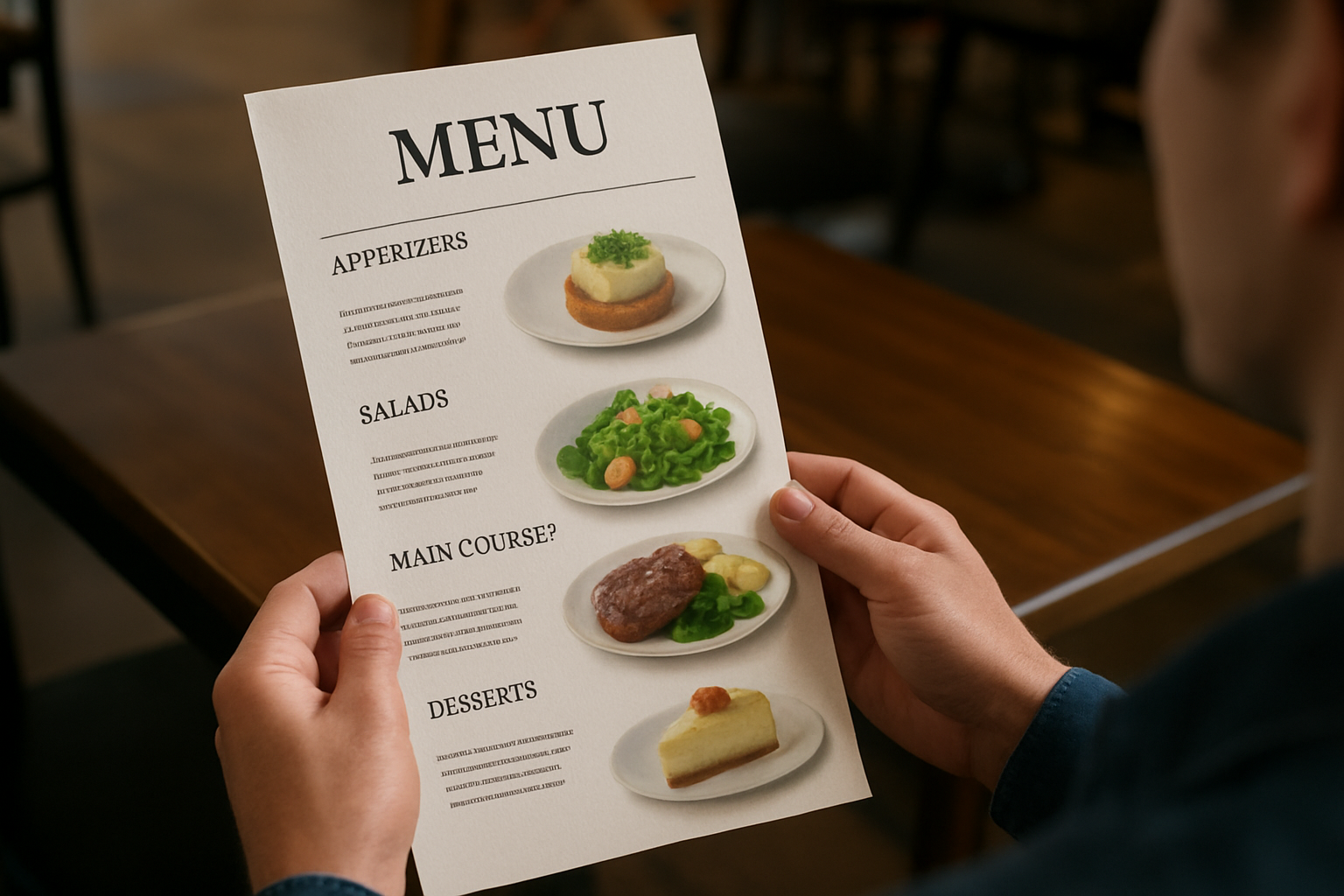
Restaurant menus are becoming a small but visible test case for AI’s tendency to smooth out the messy details that make food look real.
AI-generated menus are starting to show up in restaurants, and the problem is not just that they look cheap. It’s that they look too polished. The bagel is too symmetrical. The burger bun is too round. The shrimp looks engineered. The result lands in a strange middle ground: not obviously fake, not convincingly real, just off.
The problem is the model’s idea of “good”
TechCrunch points to a basic flaw in how generative models are trained. Large language models and diffusion models learn from huge data sets, then predict what a user wants based on patterns they have already seen. Ask for a burger menu, and the system reaches for the visual language it knows best — the familiar look of chain-restaurant menus, the kind that already lean toward idealized food photography and standardized design.
Reality Defender CTO Alex Lisle said that helps explain why so many AI food illustrations share the same look. “A lot of this stuff looks like a Chili’s menu from 2015, and there’s a reason for that,” he told TechCrunch. “That was the corpus of work from which [the models] drew their function.”
That sameness is not limited to menus. It shows up anywhere the model is trying to produce something “pleasing” and safe. Lee Rainie, director of the Imagining the Digital Future Center at Elon University, told TechCrunch that the optimization for pleasingness and non-offensiveness can turn into homogenization. “What AI is known to do both in images and language is to shave off the edges,” he said.
Why the food looks worse the more it gets edited
The weirdness gets sharper when people keep revising AI-generated menus. A user on X, Labtec, showed what happened after editing a menu in ChatGPT 100 times. TechCrunch said it replicated the experiment and found similar results: with each round of edits, the food drifted a little farther from reality and a little closer to a smooth, generic version of itself.
That pattern matters because restaurants are likely using these tools in exactly that way — making small changes to prices, item names, and layout over and over. Each pass can nudge the image further into the same rounded, overprocessed look. What starts as a passable menu can end up with food that feels more like a rendering than a meal.
Lisle described the effect as convergence rather than full model collapse. Model collapse is the more extreme failure mode, where AI systems degrade after training too heavily on their own outputs. Convergence is subtler. The system still works, but the results get flatter and less distinct.
The uncanny valley is doing real work here
There is a reason people react so strongly to these images. Researchers at the University of Duisburg-Essen in Germany found that AI-generated food images can trigger an “uncanny valley” effect, where food that looks almost real creates more disgust and unease than something that is obviously fake.
That reaction is not just aesthetic. It is tied to trust. Rainie told TechCrunch that people often know something is wrong before they can explain it. “There’s just a sensibility that people sometimes find hard to articulate, but they kind of know it when they see it,” he said.
For restaurants, that matters. A menu is supposed to sell appetite, not suspicion. When the image is too smooth, too balanced, too perfect, it stops doing the job. The customer may not be able to name the problem, but they feel it.
Beyond the menu
The restaurant example is small, but the larger issue is not. TechCrunch notes that the same trust problem extends well beyond food images. If people cannot easily tell what is real and what is synthetic, the stakes rise fast in places where authenticity is supposed to carry weight.
That is why the market for AI-detection and content-verification tools keeps growing. It is also why the backlash to AI menus has been so immediate. The issue is not only that the food looks bad. It is that the system keeps producing the same kind of bad — polished, generic, and strangely empty.